Predictive vs. preventive maintenance: what is the difference for property owners?
This guide is for owners of flats, villas and small buildings who are tired of paying for the same repair twice. Predictive maintenance in property management in India sounds technical, but the idea is simple: use the property's own history to act before something fails. You will learn the three types of maintenance, see practical examples, and get a plan you can use this year.
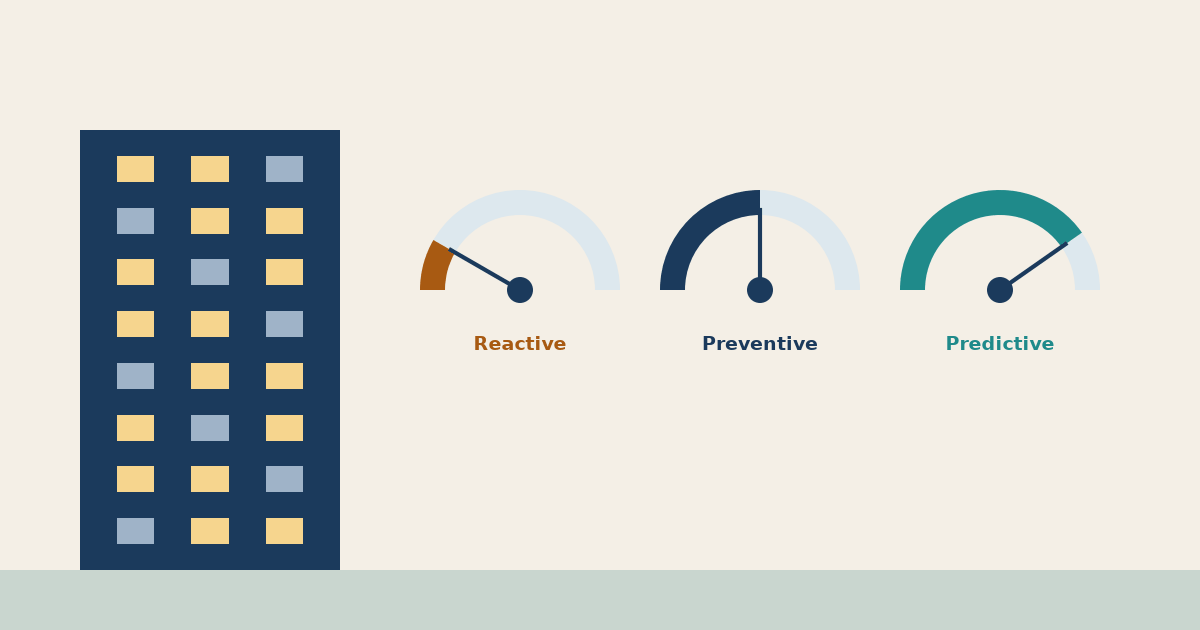
Short answer: Reactive maintenance fixes things after they break. Preventive maintenance follows a calendar. Predictive maintenance watches the condition and history of each system, so you step in when the signs appear.
Predictive maintenance in property management: three approaches
Engineers usually describe maintenance in three broad groups. The US Department of Energy's overview of operations and maintenance approaches sets them out clearly, and the same ideas apply to an apartment in Bengaluru or Kochi.
Reactive maintenance
Reactive maintenance means waiting for something to fail and then fixing it. The Department of Energy's maintenance best practices guide calls it the "run it till it breaks" mode. It costs little up front, but failures arrive at the worst time and often cause secondary damage.
Preventive maintenance
Preventive maintenance is work done on a fixed schedule, whether or not anything looks wrong. Examples include servicing a water pump every few months or cleaning drains before the monsoon. It reduces surprise failures, but some work is done before it is needed.
Predictive maintenance
Predictive maintenance bases the timing of work on the actual condition of the equipment or building element. Instead of "every six months", the rule becomes "when we see these signs". In a residential property, the signs usually come from inspection notes, repair history and simple checks.
Reactive, preventive and predictive compared
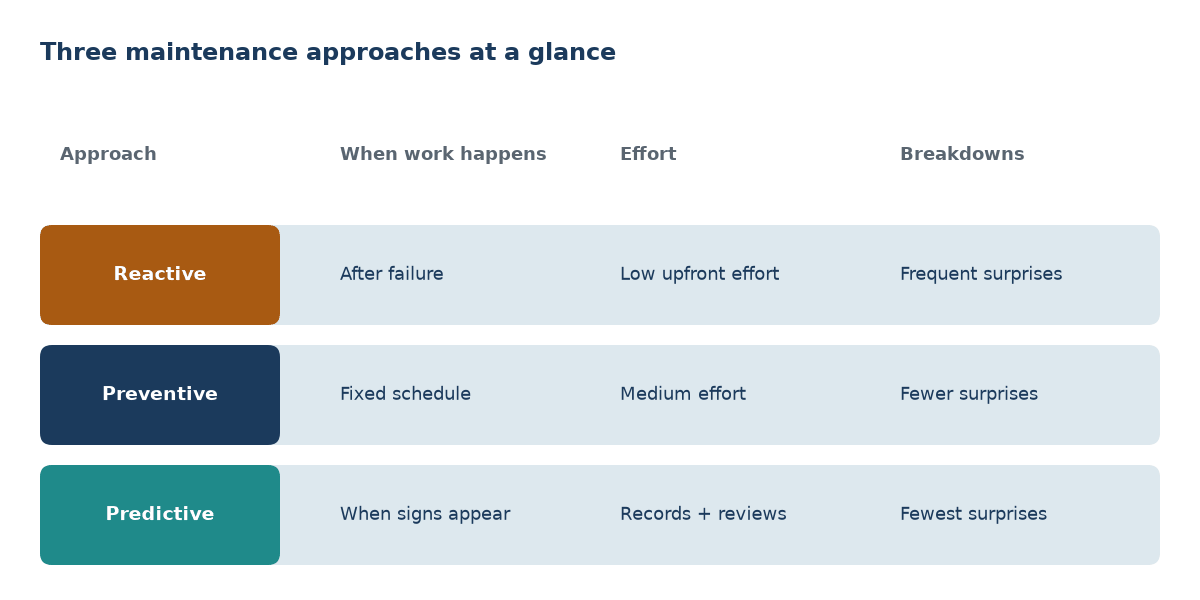
The table below compares the three approaches on the points owners care about most.
| Point | Reactive | Preventive | Predictive |
|---|---|---|---|
| When work happens | After a failure | On a fixed schedule | When condition or history shows warning signs |
| Upfront effort | Low | Medium | Medium to higher |
| Surprise breakdowns | Frequent | Fewer | Fewest, if signs are tracked |
| Unneeded work | None | Some | Less |
| What it needs | A contractor on call | A calendar and checklist | Records, inspections and someone reviewing them |
Most well-run properties use a mix. Low-value items can run until they fail.
Critical systems get a schedule. Systems with a repair history get closer watching.
Practical examples from Indian homes and buildings
Here is how the three approaches look for systems that commonly fail in Indian residential property.
Plumbing leaks and water seepage
Reactive: fix the leak once the downstairs neighbour complains. Preventive: check joints, traps and the overhead tank on a schedule.
Predictive: note every damp patch with a date and photo. If the same wall shows dampness after each heavy rain, plan a waterproofing repair before the plaster fails.
Water seepage is moisture moving through walls, roofs or floors, often from a hidden leak or failed waterproofing. It is one of the most common and costly problems in Indian flats.
Water pumps and motors
Preventive: service the pump on a fixed cycle. Predictive: watch for signs such as unusual noise, vibration, overheating or a motor that runs longer to fill the tank. Any of these can point to a worn bearing or a leak in the line.
Lifts in apartment buildings
Lifts need regular servicing by a qualified agency, and lift safety rules are set at state level. Beyond the contract schedule, track every breakdown by date. Repeated stoppages on the same fault are a signal to ask for a deeper inspection, not another quick reset.
Air conditioning and ventilation
HVAC stands for heating, ventilation and air conditioning. In most Indian flats, this means split air conditioners and exhaust fans.
Preventive: clean filters and service units before summer. Predictive: watch for weaker cooling, water dripping indoors or rising electricity bills for the same use.
Electrical systems
Preventive: an annual check of the distribution board, earthing and wiring by a licensed electrician. Predictive: log every tripping breaker, flickering light and warm socket.
A pattern in one circuit is a warning that needs a professional look. Safety faults should always be handled at once.
How inspection history helps you act earlier
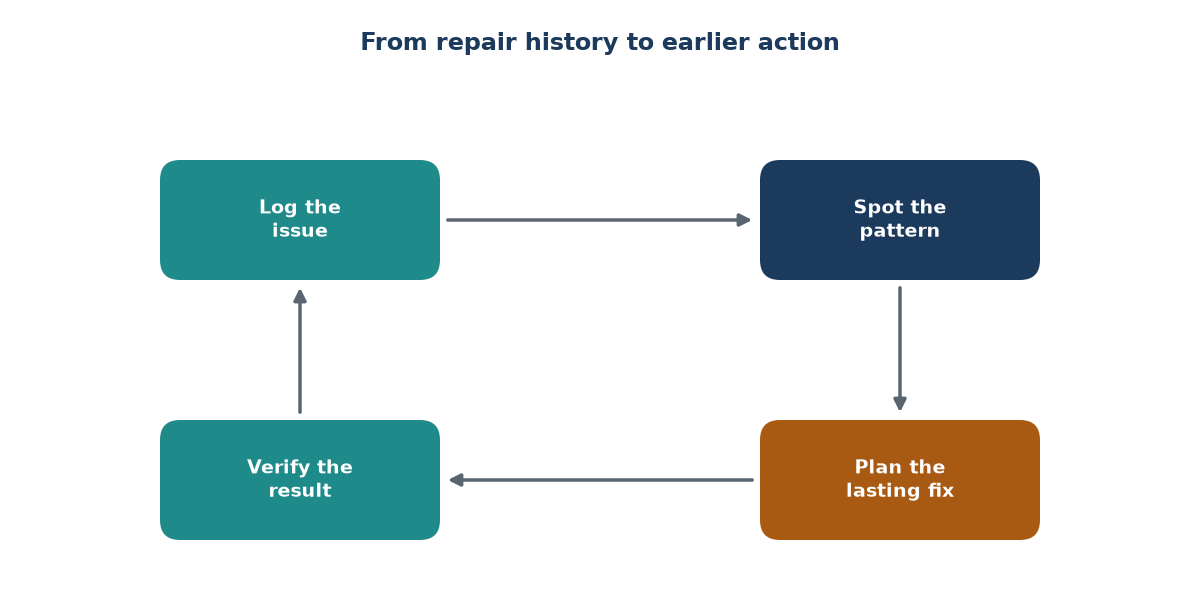
Predictive maintenance in a home does not need sensors or special software. It needs good records. The key tool is a maintenance log: a dated list of every issue, inspection and repair at the property.
Each entry should record:
- The date and the system involved, such as plumbing or electrical
- What was observed, with a photo
- What was done, by whom and at what cost
- Whether the issue had happened before
Keep the log somewhere everyone involved can reach, such as a shared spreadsheet or a property management system. A notebook in one person's bag is easy to lose.
Store photos with the date in the file name, and attach invoices to the matching entry. When a tenant changes or a manager leaves, the history should stay with the property.
Once you have six to 12 months of entries, patterns appear. The same tap, the same wall or the same breaker shows up again and again. That is your early-warning list.
Recurring issues are a system problem
If the same repair keeps happening, the problem is rarely bad luck. It may be a poor earlier repair, the wrong part, or a root cause nobody has looked at. Our guide to preventive plumbing and electrical schedules shows how to set the baseline checks.
Questions to ask before approving a repeat repair
When the same issue comes back, pause before approving another quick fix. Ask your manager or contractor:
- When was this last repaired, and what exactly was done?
- Was the root cause found, or only the symptom treated?
- Would a different part, material or method last longer?
- Is there related damage nearby that should be checked now?
- What is the cost of a lasting fix compared with repeating this repair?
The answers turn a routine approval into a better decision. They also show whether your contractor is solving problems or just attending call-outs.
An illustrative example
Picture a second-floor flat where the bathroom ceiling of the flat below shows a damp patch every few months. Each time, a plumber tightens a joint and the patch fades.
A log would show three visits for the same symptom in one year. That pattern points to a failed waterproofing layer or a cracked pipe inside the wall, which needs a proper investigation rather than a fourth visit.
A simple maintenance plan for your property
You can combine all three approaches in one plan:
- List the systems. Plumbing, waterproofing, pumps, electrical, lifts, air conditioners and common-area items.
- Rank them by risk. Ask what happens if each one fails: a safety risk, tenant disruption, or minor inconvenience.
- Choose an approach for each. Run-to-failure for low-risk items, a schedule for critical ones, and watching for anything with a history.
- Set the schedule. Put preventive tasks in a calendar, with a named person responsible.
- Start the log. Record every issue and repair from today.
- Review every quarter. Look for repeats and move those items to closer watching.
For a ready-made calendar, see our article on preventive maintenance schedules that extend asset life. Reliable vendors matter too, as covered in building a network of local contractors.
Where it differs by city
Weather shapes maintenance as much as age does. Monsoon timing and intensity differ across Bengaluru, Hyderabad, Chennai and Kochi, so seepage and drainage checks should follow your city's own rainy season. The India Meteorological Department publishes forecasts you can use to time pre-monsoon work.
Coastal cities such as Chennai and Kochi also have humid, salty air, which can speed up rust on metal fittings, railings and outdoor units. Owners in Bengaluru may find our pre-monsoon inspection checklist for Bengaluru apartments useful as a starting point.
Questions owners often ask about maintenance
Is predictive maintenance only for large buildings?
No. In a single flat, it simply means keeping dated records and acting on repeat problems. Larger buildings may add meters or monitoring devices.
Does predictive maintenance replace scheduled servicing?
No. Scheduled servicing still matters for pumps, lifts and air conditioners. Predictive watching adds a layer on top, so you catch problems between services.
How long before a maintenance log becomes useful?
Patterns often appear within six to 12 months. Even a few entries help when you are judging a contractor's quote.
What should I do first if I have no records?
Arrange one full inspection with photos. Use it as your baseline and log everything from that date.
What WWPM does
Worldwide Property Management India (WWPM) carries out regular inspections and coordinates repairs through a vetted local contractor network. Every repair is documented with photos and cost breakdowns, so you can see what was done, when and why. Learn more about our property maintenance and repairs service.
One practical test for your property
Look back over the last 12 months of repairs on your property. If any item appears twice or more, write it down. That short list is where predictive maintenance should start.
Plan maintenance before it becomes repair
Predictive maintenance in property management in India is not about gadgets. It is about records, regular checks and acting on patterns early. To put that system in place for your property, build a proactive maintenance plan with WWPM.
WWPM | wwpm.in | [email protected]
Sources and date
Information checked on 12 November 2026.
- US Department of Energy, Federal Energy Management Program, Operations and Maintenance Challenges and Solutions
- US Department of Energy, Operations and Maintenance Best Practices Guide, Release 3.0, Chapter 5 (PDF)
- India Meteorological Department website
