
Managing a property in India while living abroad: the NRI owner's checklist
This checklist is for non-resident Indian (NRI) owners who rent out a flat or house in India while living overseas. Good NRI property management in India comes down to a few jobs done on time, with proof you can check from abroad. By the end, you will know what must happen on the ground, who should do it and what evidence you should receive each month.
Short answer: Appoint one accountable local representative, verify every tenant, put rent and repairs on a written routine, and insist on dated, documented monthly updates.
Why NRI property management in India needs a plan
Owning a rental flat is the same job wherever you live. What changes is that you cannot drop by. You cannot check a leak yourself, meet a prospective tenant or sign a document at short notice.
Time zones make this harder. A tenant in Bengaluru reports a problem at 10 a.m., which may be the middle of the night in New Jersey. If every decision waits for you, small problems grow.
The answer is not to approve less. It is to decide in advance what your representative can approve alone, and what must come to you.
Step 1: choose trusted local representation
Every NRI owner needs someone on the ground. This can be a family member, a friend or a professional property manager. What matters is that one person is clearly responsible.
Agree what they can do for you
Write down the representative's authority. Many owners set a spending limit, such as small repairs up to an agreed amount, with anything above it needing approval by email. Agree how fast they should tell you about an emergency.
Decide whether you need a power of attorney
A power of attorney (POA) is a legal document that lets another person act for you, such as signing an agreement or dealing with an authority. It can be general or limited to specific tasks. Our guide to structuring an NRI power of attorney explains the options.
A POA signed abroad usually needs attestation and may need registration in India. Check the current process with the Indian mission in your country and a lawyer in the state where the property sits.
Step 2: verify every tenant before move-in
A careful tenant choice prevents most later problems. For an owner abroad, it matters even more, because problems are harder to fix from a distance.
A sound tenant check covers:
- Identity and current address, using government-issued documents
- Employment or income, where appropriate for the rent level
- References from a previous landlord, where available
- Who will live in the flat, and how many people
- Police verification, where the city or state requires or offers it
Apply the same criteria to every applicant and record why you chose one. Our article on background screening protocols for tenants in India goes deeper.
Step 3: put the rental agreement in writing
A rental agreement is the written contract between you and the tenant. It should state the rent, deposit, duration, notice period, rent revision, who pays which bills and who handles which repairs.
Registration rules and stamp duty differ by state. Make sure the agreement is stamped and, where required, registered in the state where the property is located.
Step 4: set up rent collection you can track
Rent should arrive on a fixed date, by bank transfer, with a clear reference. Avoid cash, because it leaves no record. A simple tracker should show rent due, rent received and any shortfall each month.
Banking and tax points to confirm
Many NRI owners receive rent into a Non-Resident Ordinary (NRO) account, which is a rupee account in India for income earned in India. Ask your bank which account suits your situation, and read our guide on repatriation risks for NRI rental income before moving money abroad. The Reserve Bank of India sets the foreign exchange rules for NRI-owned property, and its master circular on immovable property held by NRIs is the official reference.
Tax rules also differ for non-resident landlords. The Income Tax Department notes that tax on rent payable to a non-resident is deducted under Section 195 rather than the resident rent rule.
Section numbers changed with the new Income-tax Act, so confirm the current reference with a tax professional. Our explainer on TDS on rent covers the basics.
This post is general information, not legal or tax advice. Confirm your own case with a qualified professional.
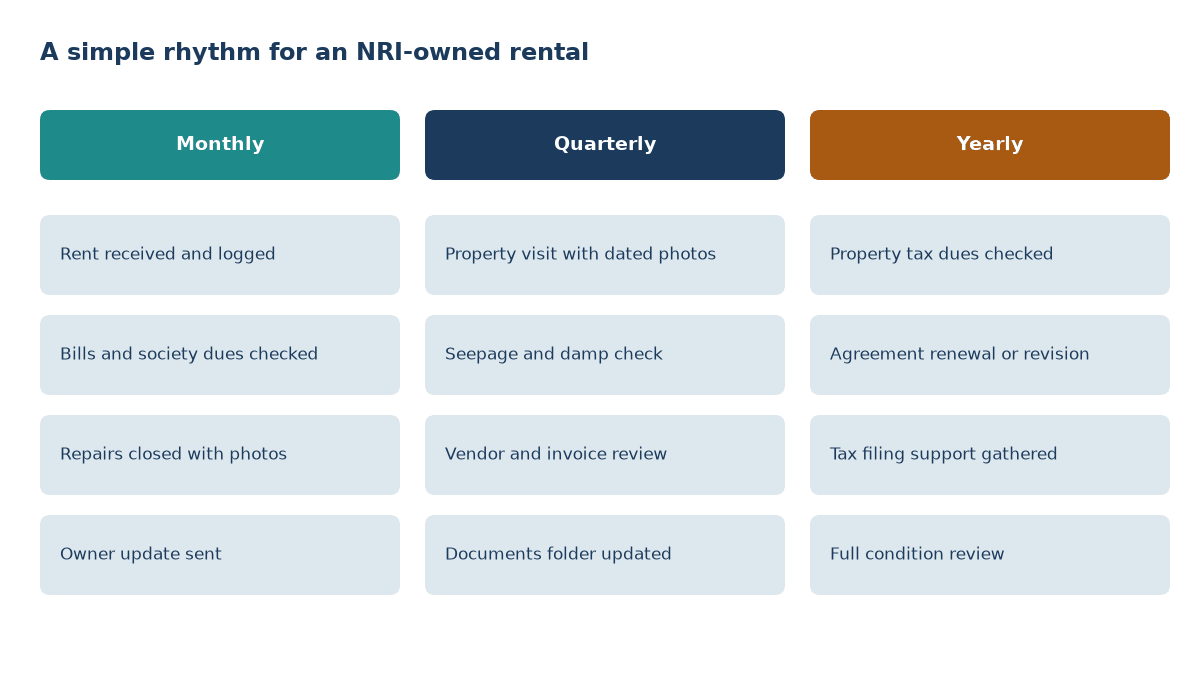
Step 5: agree how maintenance approvals work
Repairs are where distance hurts most. Agree three levels in advance:
- Emergencies: water leaks, power failures and safety issues. Your representative acts first and informs you the same day.
- Routine repairs under your limit: handled and reported with photos and the invoice.
- Larger work above your limit: at least one written quote, photos of the problem, and your approval before work starts.
Every repair should leave a record: what broke, who fixed it, what it cost and a photo of the finished job.
Step 6: keep utility bills and dues under control
Unpaid bills can lead to disconnection, penalties or friction with your housing society. Make a list of every recurring charge on the property:
- Electricity and water bills
- Gas connection, if any
- Society or apartment association maintenance charges
- Municipal property tax
Note who pays each one, the tenant or you, and when it falls due. Our year-end property tax and utility audit checklist helps you review them once a year.
Step 7: schedule property visits and inspections
Someone should see the property on a set schedule, not only when a problem is reported. A quarterly visit is a common rhythm for a tenanted flat, with a full check at move-in and move-out.
Each visit should produce dated photos of key areas: kitchen, bathrooms, balconies, ceilings and walls. Look for seepage, damp patches and damage. With the tenant's agreement, the visit should be at a time that suits them.
Step 8: keep documents organised and reachable
Keep scanned copies of the sale deed, Khata or property records, tax receipts, the rental agreement, the tenant's documents and every major invoice in one shared folder. Name files with dates so you can find them quickly.
A Khata is a property record used by municipal bodies in Karnataka, including Bengaluru, for property tax and ownership details. Other states use different records and names.
Step 9: insist on transparent monthly updates
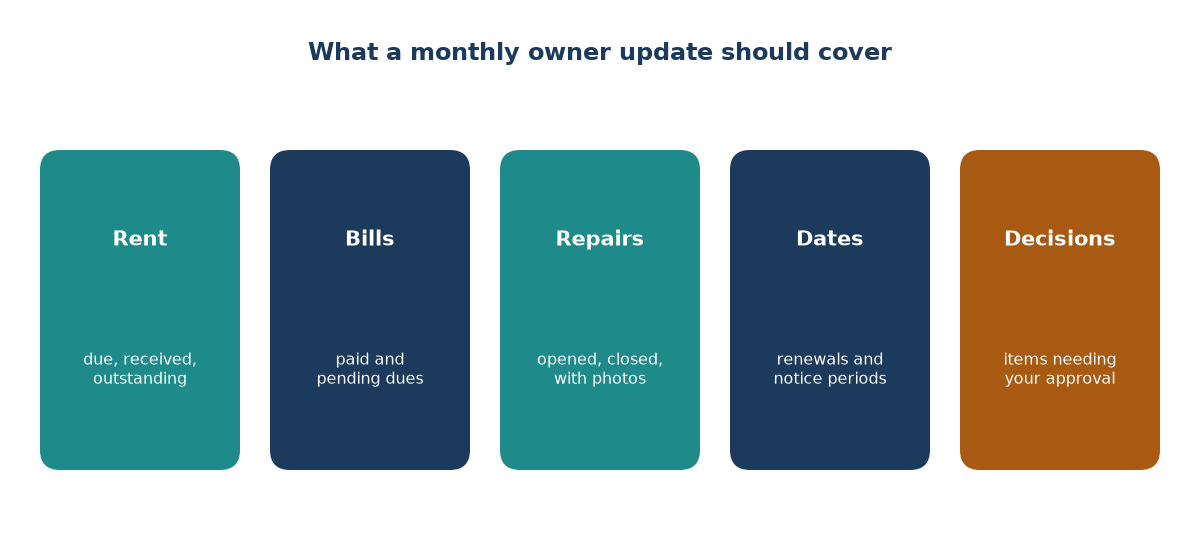
A monthly update is your window into the property. It should be short, dated and traceable. It should include:
- Rent due, received and outstanding
- Bills paid and any pending dues
- Maintenance requests opened and closed, with photos
- Upcoming dates, such as renewals and notice periods
- Decisions that need your approval
Step 10: plan renewals and move-outs early
Most rental disputes start at the end of a tenancy. Set a reminder at least two months before the agreement ends. That gives you time to decide whether to renew, revise the rent or look for a new tenant.
At move-out, compare the flat with the move-in photos and inventory. Note damage beyond normal wear and tear, agree deductions in writing and return the balance of the deposit promptly.
Plan the gap between tenants too. Use it for painting, deep cleaning and any repairs that are hard to do while someone lives there.
Where it differs by city
Tenancy rules, agreement registration, stamp duty and police verification are set at state or city level. Do not assume what applies in Bengaluru also applies in Chennai, Hyderabad or Kochi.
For example, the Tamil Nadu Police citizen portal lists tenant verification among its online police verification services. In Karnataka, Telangana and Kerala, confirm the current process with the local police station or the state police website. Rules can change, so check again before each new tenancy.
Questions NRI owners often ask
Can I manage my Indian property without visiting India?
Yes, if someone on the ground is accountable and the paperwork allows them to act. Some steps, such as registering a document, may need you or a POA holder present.
How often should someone inspect my flat?
A quarterly visit suits most tenanted flats, plus checks at move-in and move-out. Older buildings, or those in heavy-rain areas, may need more frequent checks.
What should I do if the tenant stops paying?
Follow the notice and dispute steps in your agreement and state law. Start with a calm written reminder before any formal notice.
Do I need a separate bank account for rent?
Many NRI owners use an NRO account for Indian income. Your bank can confirm which account fits your situation.
What WWPM does
Worldwide Property Management India (WWPM) supports NRI and other absentee owners in Bengaluru, Hyderabad, Chennai and Kochi. We screen tenants and you approve the final choice before move-in.
Repairs go through a vetted local contractor network, and each one is documented with photos and costs. Read more about our NRI property management services.
One practical test for owners abroad
Ask yourself one question: if your representative were unavailable for a month, could someone else pick up the work from your records alone? If the answer is no, start with Step 8 and fill the gaps in your documents this week.
Take the next step with confidence
NRI property management in India works when local action, clear authority and monthly proof come together. To learn how we support owners overseas, explore WWPM's NRI property management support.
WWPM | wwpm.in | [email protected]
Sources and date
Information checked on 12 November 2026.
- Income Tax Department, TDS on Rent by Certain Individual or HUF (PDF)
- Reserve Bank of India, Master Circular on acquisition and transfer of immovable property in India by NRIs/PIOs
- Tamil Nadu Police, Police Verification Report (PVR) FAQ
