Beyond chatbots: 7 property management workflows AI can actually improve
If you own a flat, a villa or a small portfolio in Bengaluru, Hyderabad, Chennai or Kochi, you have probably heard big promises about AI in property management in India. This guide is for owners who want to know where AI helps with real work, and where it should stay out of the way. You will see seven workflows, the checks each one needs, and how to judge any manager who says they "use AI".
Short answer: AI is most useful when it sorts, reminds, extracts and summarises. People should still approve anything that touches money, a tenant's rights or a legal notice.
Why AI in property management in India goes beyond chatbots
Most owners first meet AI as a chatbot that drafts replies. That is helpful, but a polite reply does not fix a leaking pipe or collect overdue rent. The real gains come when AI moves a task to the next step.
Think of a property as a chain of small jobs. A tenant reports a problem, someone sorts it, a vendor is booked, the work is checked and the owner is told.
AI can speed up the sorting, reminding and reporting links in that chain. It cannot replace the person who inspects the work or signs off the cost.
What we mean by an AI workflow
An AI workflow is a repeatable task where software reads information, suggests an action and hands it to a person or system. A large language model is the type of AI that reads and writes text, such as a tenant message or a report.
Pattern-matching tools handle numbers and dates. Both make mistakes, so every workflow below includes a human check.
Seven AI property management workflows worth using
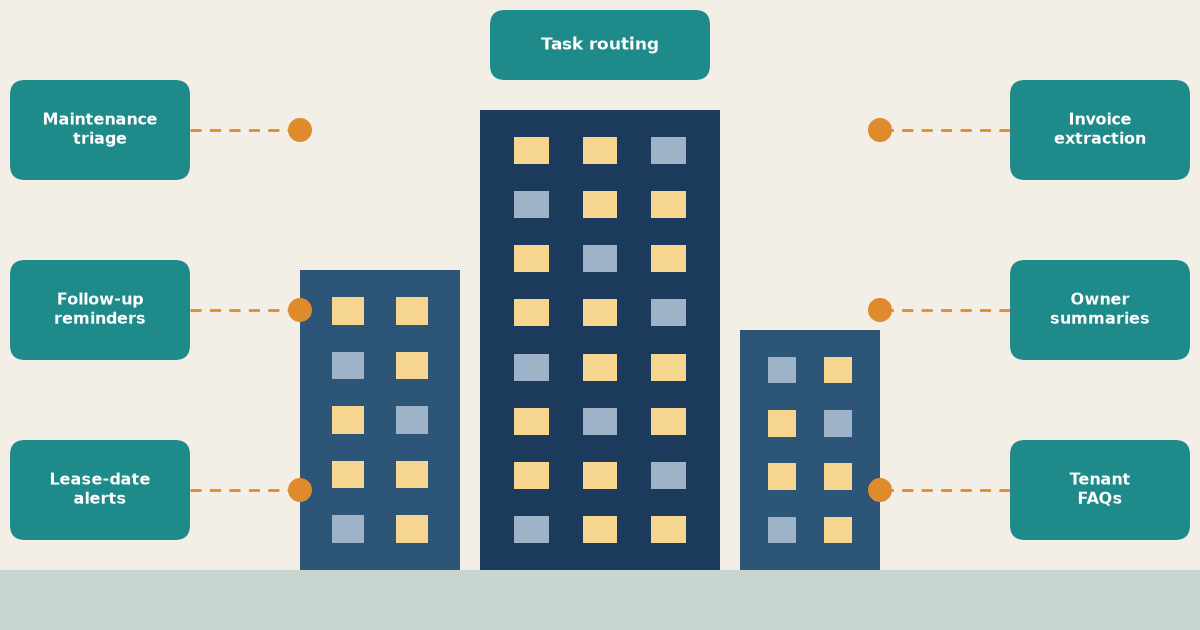
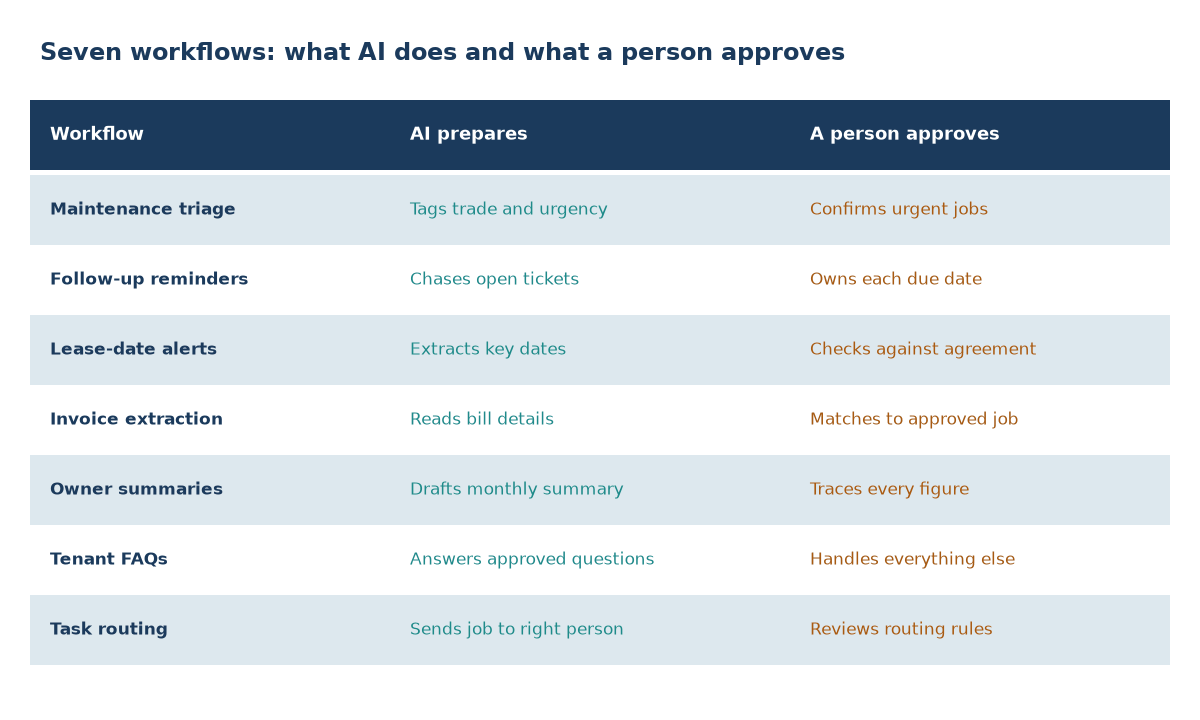
These seven AI property management workflows cover most of the daily admin on a rented flat or a small building. Each one names the job, what AI can do and what a person must still do.
1. Maintenance request triage
Tenants describe problems in their own words: "water near the bathroom wall" or "no power in one room". AI can read the message, tag the trade (plumbing, electrical, civil) and suggest an urgency level. That helps the right technician get the job sooner.
A person should confirm anything flagged urgent, such as a gas smell, sparking socket or ceiling seepage. Our guide to building a reliable network of local contractors explains what happens after the job is sorted.
2. Follow-up reminders that do not slip
Open jobs often stall because nobody chases them. AI can watch every open ticket and send a reminder when a vendor has not confirmed a visit, or when a tenant has not confirmed the repair is done. It can also nudge the owner when an approval is pending.
The rule is simple: reminders should go to a named person, with a due date. A reminder with no owner is just noise. The same logic applies to rent, as our guide to automating rent collection workflows explains.
3. Alerts for key lease dates
Missed dates cost money. AI can read a signed rental agreement and pull out key dates: start, lock-in end, renewal, rent revision and notice period. It then sets alerts well before each date.
Always check the extracted dates against the signed document. If you want to tighten the agreement itself, read how to structure an Indian residential lease agreement first.
4. Reading vendor invoices automatically
Vendor bills arrive as photos, PDFs and WhatsApp images. Optical character recognition (OCR) is software that turns text in an image into editable text. Combined with AI, it can read the vendor name, date, amount and tax details and place them in a ledger.
A person should match each invoice to an approved job before payment. This catches duplicate bills and work that was never authorised.
5. Summaries for monthly owner reports
Monthly statements can be long. AI can turn rent received, expenses, open jobs and upcoming dates into a short summary: what changed, what needs your decision and what is due next. Our article on setting up transparent financial reporting for remote owners shows what a good report should contain.
The summary must link back to the source figures. If a number in the summary cannot be traced to a ledger entry, it should not be sent.
6. Answering routine tenant questions
Tenants ask the same questions every month: the rent due date, how to report a repair, where the water meter is, or how visitor parking works. AI can answer these from an approved set of answers for that building.
Anything outside the approved list should go to a person. Questions about deposits, disputes or notices are never chatbot work.
7. Task routing across a team
When several people manage a portfolio, jobs land in the wrong inbox. AI can route each task by property, trade and city to the right coordinator. That gives every job a clear owner from day one.
Routing rules should be reviewed every few months, because teams and vendors change.
Where human approval must stay
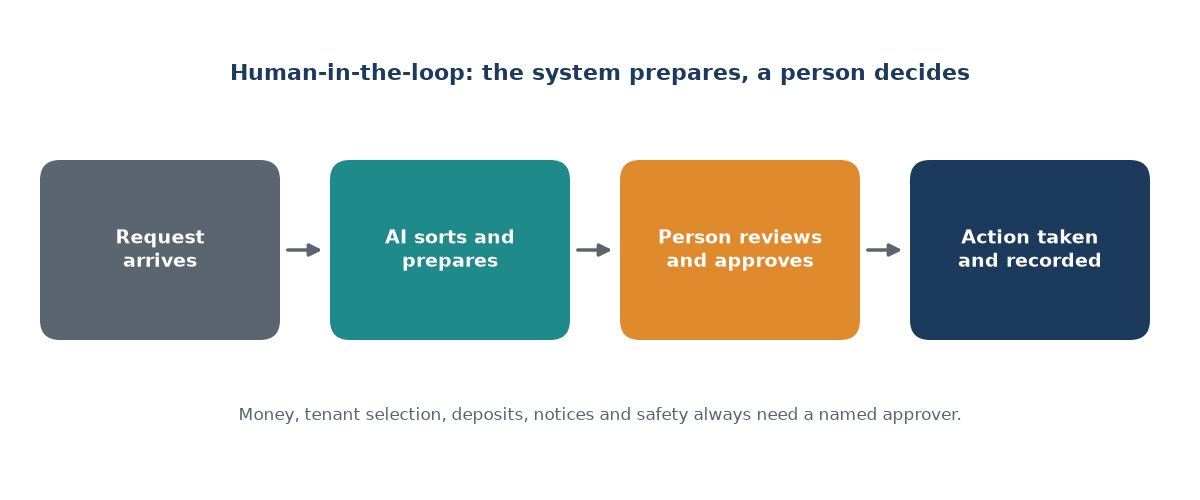
AI is fast, but it does not carry responsibility. Some decisions should always need a named person to approve them:
- Spending above a limit you set as the owner
- Choosing or rejecting a tenant
- Deposit deductions and refunds
- Legal notices, rent revisions and agreement changes
- Anything involving a tenant's safety
This is often called human-in-the-loop design: the system prepares the work, and a person makes the final call. The US AI Risk Management Framework from NIST is a widely used, voluntary guide to this kind of oversight.
Data protection comes first
Property work involves personal data: names, phone numbers, ID documents and bank details. India's Digital Personal Data Protection Act, 2023 sets rules for how organisations collect and use digital personal data. Before any AI tool handles tenant or owner information, ask where the data is stored, who can see it and how long it is kept.
This section is general information, not legal or tax advice. Confirm your own obligations with a qualified professional.
How to judge a manager who says they use AI
Many firms now mention AI in their pitch. These questions help you test the claim:
- Which tasks does AI handle, and which does a person approve?
- Can you show me a sample owner report and the source data behind it?
- How are urgent maintenance requests checked?
- Where is tenant and owner data stored, and who can access it?
- What happens when the AI gets something wrong?
A good answer is specific. A vague answer, such as "our AI handles everything", is a warning sign.
A 30-day plan to start small
You do not need to change everything at once. A short pilot on one property shows what works before you scale it. Here is a simple plan an owner and manager can follow together:
- Week one: map the work. List every recurring task on the property for one month, such as rent follow-ups, repair requests, bills and renewals. Note who does each one today.
- Week two: pick two workflows. Choose low-risk tasks, such as lease-date alerts and maintenance follow-ups. Write down the approval rule for each one.
- Week three: run side by side. Let the tool suggest actions while a person still does the work manually. Compare the two and note every error.
- Week four: review and decide. Keep what saved time without errors. Drop what needed constant correction, and record the reasons.
Keep a short log during the pilot. It should show the date, the task, what the tool suggested and what the person decided. That log becomes your evidence when you decide whether to expand.
Signs the pilot is working
- Fewer missed dates and fewer stalled repair tickets
- Owner updates arrive on time and match the ledger
- Tenants get clear answers to routine questions faster
- Staff spend less time chasing and more time inspecting
Questions owners often ask about AI
Will AI replace my property manager?
No. AI handles sorting, reminders and summaries. Inspections, vendor checks, tenant decisions and legal steps still need accountable people on the ground.
Is it safe to share tenant documents with an AI tool?
Only if you know where the data is stored, who can access it and how long it is kept. Share the minimum needed, and avoid tools with no clear data policy.
Which workflow should an owner automate first?
Start with lease-date alerts and maintenance follow-ups. They are low risk, easy to check and prevent the most common missed deadlines.
Does AI work for a single flat, or only for large portfolios?
It works for both. A single-flat owner benefits most from date alerts and organised records, while larger portfolios gain more from routing and summaries.
Can AI set the rent for my flat?
AI can summarise comparable listings, but the final rent should be set by a person who knows the micro-market and your agreement terms.
What WWPM does
At Worldwide Property Management India (WWPM), we combine hands-on local management with technology-driven systems. Maintenance is coordinated through a vetted contractor network, and every repair is documented with photos and cost breakdowns.
You approve the tenant before move-in, and compliance paperwork is handled before it becomes a problem. You can see the full list on our property management services page.
One practical test before you choose
Pick one recent repair on your property. Ask your manager to show you the original request, who sorted it, when the vendor was booked, the invoice and the completion photo. If they can show that trail in minutes, their system works, whether or not it uses AI.
Bring order to your property operations
AI in property management in India works best as a disciplined assistant inside a clear process, not as a replacement for accountable people. If you want that kind of system for your property, get a more organised property management system with WWPM.
WWPM | wwpm.in | [email protected]
Sources and date
Information checked on 12 November 2026.
- National Institute of Standards and Technology (NIST), AI Risk Management Framework
- Ministry of Electronics and Information Technology, The Digital Personal Data Protection Act, 2023 (Gazette of India)
